Roof access is one of those building requirements that’s easy to under-think. The hatch is small, the run is tall, the footprint at the base is tight, and for decades the default answer has been a fixed vertical ladder—often a caged one. It checks the “we have access” box, and that’s about all it does.
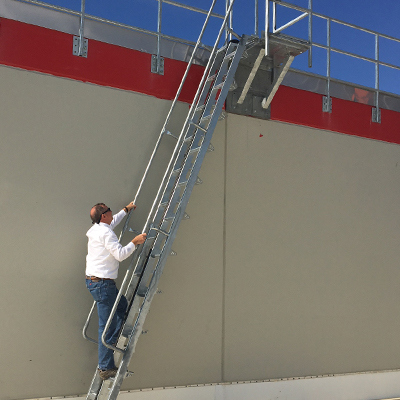
But “access” and “safe, repeatable, usable access” are not the same thing. Maintenance techs carry tools. HVAC and refrigeration crews make the climb several times a shift. Inspectors, roofers, and contractors come and go. Every one of those trips up a vertical ladder is a three-points-of-contact balancing act with hands that would rather be holding something else.
The alternating tread stair (ATS) solves the same problem the ladder was trying to solve—getting people through a roof hatch in a tight footprint—without forcing the climb-a-ladder compromise. Here’s why it’s become the go-to for roof access, and what to know before you spec one.
The footprint problem alternating tread stairs were built for
The reason ladders dominated roof access for so long isn’t that they’re good. It’s that they’re compact. A conventional 30-to-35-degree stair eats up an enormous horizontal run as it climbs, and there’s rarely room for that near a roof hatch.
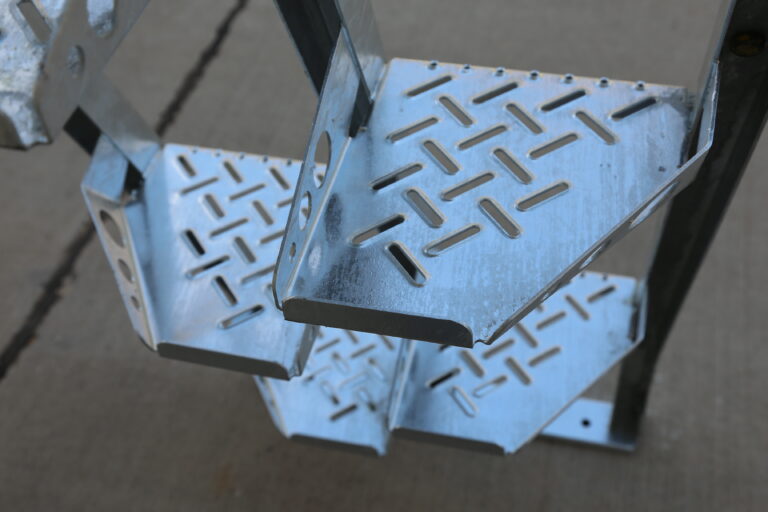
An alternating tread stair designed for roof access threads this needle. By staggering left and right treads, it lets a person climb at a steep 56- or 68-degree angle—closer to a ladder’s pitch than a stair’s—while still walking up and down facing forward. You get a stair’s usability in a ladder’s footprint. When used for rooftop hatch access, the ATS can eliminate the need for additional structures to make the access work.
That single property—stair ergonomics at a ladder’s pitch—is the whole argument, and it’s why the ATS is the centerpiece of nearly every modern roof access design.
Descending forward beats climbing blind
On a vertical ladder, you descend backward, feeling for rungs you can’t see, with both hands committed to the rails. On an alternating tread stair, you face forward going up and coming down, with a continuous handrail at a natural grip height. You can see your feet. You can see the surface you’re stepping onto. You can carry a tool bag without turning the descent into a one-handed gamble.
This matters most where it’s most dangerous: the transition at the top, right at the hatch opening. That’s the pinch point on any roof access, and it’s where the ATS’s forward-facing geometry and extending handrails do the most work.
The cage myth, and what actually protects people
If your current roof access is a caged ladder, it’s worth knowing the cage is doing less than it looks like it is. Studies have shown that cages don’t actually protect a falling worker—a person who loses their grip falls inside the cage and can strike the rungs and hoops on the way down. This is why guidance has shifted toward replacing caged ladders with genuine fall protection rather than treating the cage as a safety feature.
We dug into this in detail in Roof Access Ladders: Why Vertical Caged Ladders Are Falling Behind, and where the ATS lands relative to ladders, gates, and PFAS in Fall Protection Systems Ranked: From Minimum Compliance to Maximum Safety. The short version: the alternating tread stair moves you up the safety hierarchy without giving up the compact footprint that made the ladder attractive in the first place.
Built for the hatch, down to the curb
A roof access stair isn’t just a stair you happen to point at a hatch. The geometry has to respect the opening. Lapeyre’s roof hatch alternating tread stairs come standard with low-profile handrails sized to fit within a standard 12-inch hatch curb, extending 6¾ inches above the top landing on both steel and aluminum models—high enough to give you something to hold through the transition, low enough to clear the curb.
Every roof access stair also comes standard with extending handrails mounted on either the left or right side, so the grip carries you past the landing and through the hatch rather than stopping short of it. The handrail extension is the difference between “there’s a rail on the stair” and “there’s a rail where I actually need it,” which on a roof hatch is at the very top.
These stairs are built to exact vertical height. For a roof hatch, that height is measured from where the top landing sits flush with the finished roof surface down to the finished floor where the foot of the stair is secured—so the fit is dialed in to your building, not approximated.
Specs worth knowing
A representative roof hatch ATS configuration—carbon steel, 56-degree, 240-inch stair height with a left-hand rail extension—runs through 32 risers at a 7.5-inch riser height and a 10.5-inch tread depth, rated to a 1,000-pound capacity and compliant with OSHA and IBC Industrial standards. That gives you a feel for the scale these handle: a full 20-foot rise through a hatch, still in a footprint a conventional stair couldn’t touch.
Across the line, roof access stairs are offered in:
- Heights from 24 to 240 inches (ATS), with custom heights built to exact specification in 1/8-inch increments
- Materials including carbon steel, plus aluminum and stainless for the alternating tread stair
- Finishes from powder-coated safety yellow or iron gray to custom RAL colors, gray primer, or galvanized (recommended for outdoor and rooftop exposure)
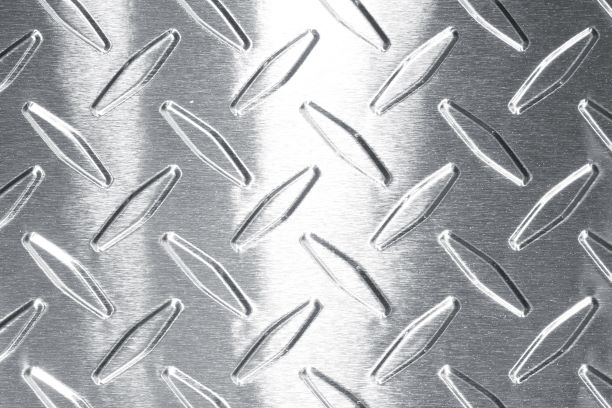
- Treads in bar grating, grip tread, or diamond plate, with open or closed risers
- Compliance with both IBC Commercial and IBC Industrial standards
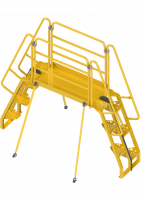
They arrive assembled and ready to install, and crossover stair configurations are available where a parapet has to be cleared.
Choosing the right way up
If you’re weighing roof access options, the decision usually comes down to three questions. How often will people make the climb? What are they carrying? And how much room is there at the base? The more often, the more loaded, and the tighter the space, the stronger the case for an alternating tread stair over a ladder—because that’s exactly the trade-off the ATS was designed to resolve.
For low-traffic, hands-free access where space is brutally tight, a ladder may still be defensible. But for the maintenance reality of most rooftops—repeated trips, tools in hand, equipment to service—the alternating tread stair gives you a safer, more usable climb without asking for floor space you don’t have.
Ready to spec roof access for your building? Build a roof hatch stair quote, shop roof hatch stairs, or talk to a stair expert about your hatch dimensions and traffic.