Fall protection isn’t a single product—it’s a hierarchy of solutions. And understanding where each system fits is the difference between checking a compliance box and actually protecting your people.
For decades, many facilities defaulted to vertical ladders with cages as their primary access solution. But regulations—and more importantly, real-world safety data—have changed.
Today, the question isn’t “Are we compliant?”
It’s “Are we using the safest system available?”
The Fall Protection Hierarchy (Ranked Worst → Best)
Below is a practical ranking of common fall protection systems used in industrial environments; based on risk reduction, usability, and long-term compliance.
6. Fixed Vertical Ladders (No Protection)
Risk Level: EXTREME
This is the most basic, and most dangerous, form of access.
- Requires constant 3-point contact
- No fall arrest capability
- High fatigue and slip risk
- Not viable for frequent access
OSHA requires fall protection at relatively low heights (4′ in general industry), and ladders over 24′ must include additional systems.
Reality: This is not a fall protection system, it’s just access.
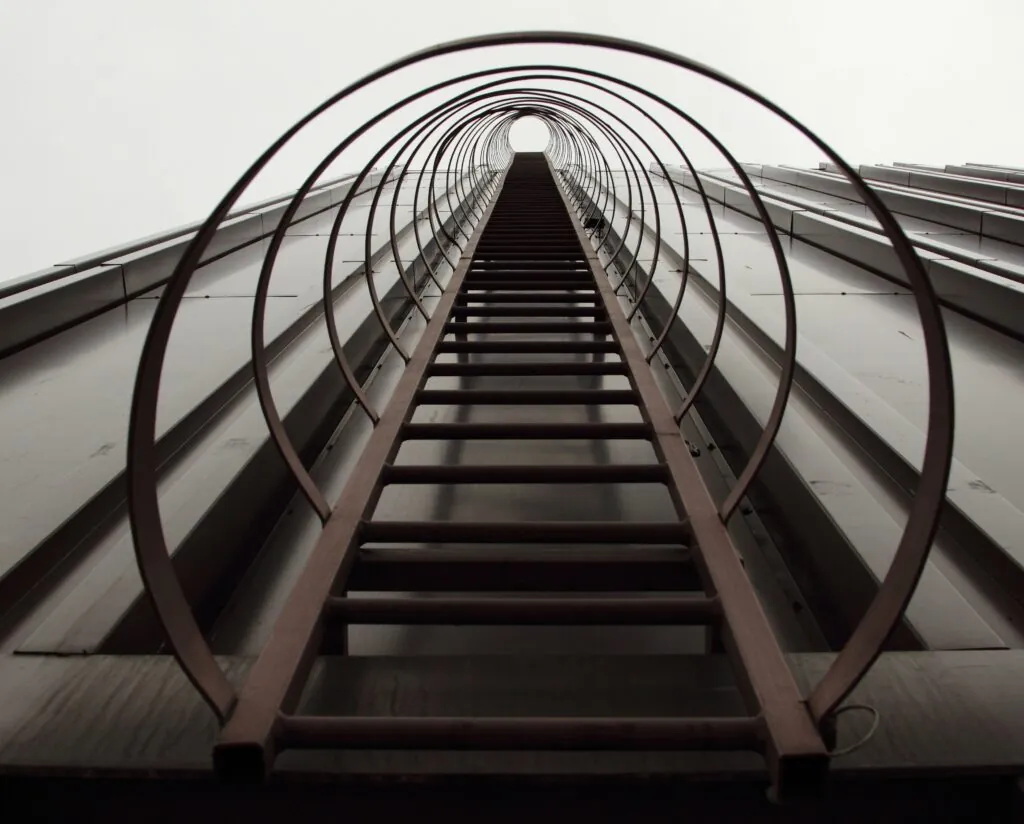
5. Caged Ladders (Being Phased Out)
Risk Level: VERY HIGH
Caged ladders were once considered “safe.” We now know better.
- Cages do not stop falls, they only surround the climber
- Workers can still fall vertically and strike the cage
- Rescue is more difficult and dangerous
OSHA has formally moved away from cages:
- Not accepted for new ladders after 2018
- Must be replaced by 2036 deadline
- No longer considered effective fall protection
Key Insight: Cages provide a false sense of security, not actual fall arrest.
4. Ladder Safety Systems (Cable or Rail)
Risk Level: HIGH (but compliant)
Modern ladder systems improve safety by adding:
- Vertical lifelines or rigid rails
- Harness + connection device
- Automatic fall arrest
These systems are now required for ladders over 24 ft.
Pros:
- OSHA-compliant
- Arrests falls within inches
- Retrofit-friendly
Cons:
- Requires training and PPE
- User-dependent (compliance risk)
- Still physically demanding
Reality: Better than cages, but still built on the limitations of ladders.
3. Personal Fall Arrest Systems (PFAS)
Risk Level: MODERATE
PFAS includes:
- Harness
- Lanyard or SRL
- Anchor point
Pros:
- Highly effective at stopping falls
- Required in many elevated work scenarios
Cons:
- Relies on perfect human behavior
- Requires training, inspection, and enforcement
- Doesn’t eliminate the hazard, only mitigates it
Key Insight: PFAS protects the worker after a mistake, not before.
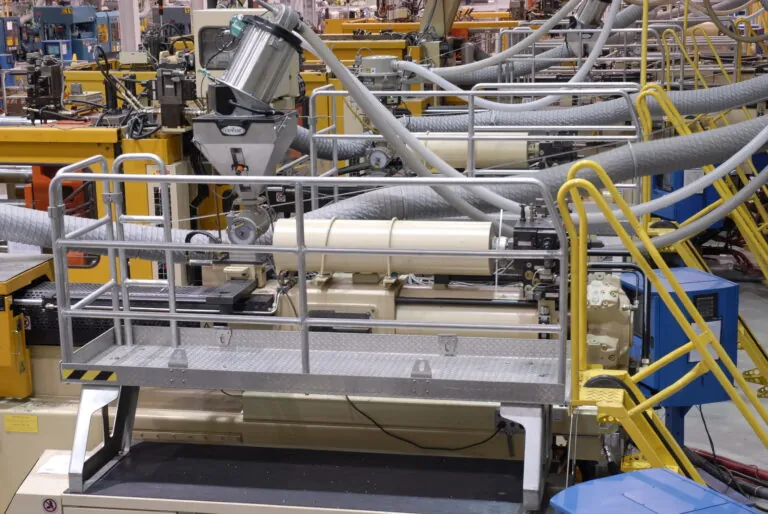
2. Guardrails & Passive Protection
Risk Level: LOW
Guardrails represent passive fall protection, no user action required.
- Always in place
- No training required
- Eliminates exposure at edges
OSHA consistently prioritizes passive systems like guardrails over active systems like harnesses.
Limitations:
- Doesn’t solve vertical access challenges
- Often combined with stairs or platforms
Reality: One of the safest solutions, but incomplete on its own.
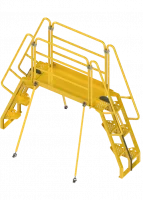
1. Alternating Tread Stairs (ATS), The Safer Access Standard
Risk Level: LOWEST (Best Overall Solution)
This is where the conversation shifts from fall protection to fall prevention by design.
Alternating Tread Stairs (ATS):
- Reduce ladder angle while maintaining a compact footprint
- Allow face-forward ascent and descent
- Provide stable footing and handrail support
- Minimize fatigue and human error
Why ATS Outranks Ladders:
| Factor | Ladder | ATS |
|---|---|---|
| User posture | Vertical climb | Natural walking motion |
| Load carrying | Limited | Practical |
| Fall risk | High | Significantly reduced |
| Training required | Moderate–High | Minimal |
| OSHA trend | Restricting | Favorable |
Key Insight:
The safest fall protection system is the one that eliminates the need to fall in the first place.
The Bigger Shift: From Fall Protection → Safer Access Design
OSHA’s evolution tells a clear story:
- Cages → phased out
- Ladders → increasingly regulated
- Fall arrest → required but reactive
- Safer access systems → preferred direction
Why?
Because:
- Cages don’t stop falls
- Fall arrest systems only activate after failure
- Human error is inevitable
What This Means for Your Facility
If your facility still relies on:
- Caged ladders
- Long vertical climbs
- PPE-dependent safety
You’re not just facing future compliance risk—you’re carrying current safety risk.
And with the 2036 deadline approaching, the shift away from ladders isn’t optional—it’s inevitable.
How to Choose the Right System
Use this simple framework:
- Frequent access? → ATS or stairs
- Hands needed for tools/materials? → ATS
- Long climbs (>20 ft)? → Avoid ladders entirely if possible
- Retrofit constraint? → Ladder safety system (short-term fix)
- New design? → ATS + platform + guardrails
Final Takeaway
Most fall protection systems are designed to catch you after a mistake. Alternating Tread Stairs are designed to prevent the mistake entirely.
And that’s where the industry is heading.