Short answer: No. OSHA’s three-points-of-contact requirement applies to ladders, not to stairs, and that difference is not a loophole or an oversight. It’s the clearest expression of what separates the two, and it has real consequences for how you should think about access in your facility.
Where the rule actually lives
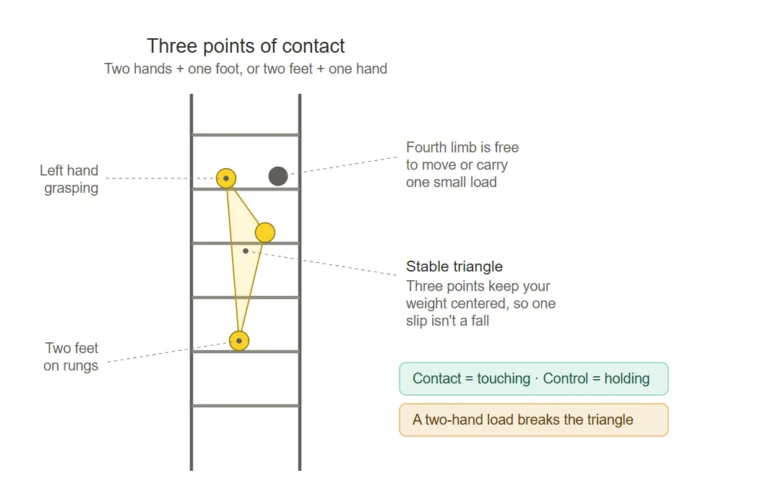
The three-points-of-contact requirement is a ladder rule. It comes from 29 CFR 1910.23(b) — the general industry standard for ladders — which directs employers to ensure workers face the ladder while climbing, keep at least one hand grasping it, and avoid carrying loads that could throw them off balance. Taken together, those provisions are what the industry calls three points of contact.
Stairs are governed by a different standard entirely: 29 CFR 1910.25, covering stairways. That standard sets requirements for things like riser height, tread depth, handrails, and stair rail systems — the design of the stair, rather than a body-position discipline the climber has to maintain on every trip. There is no three-point-of-contact mandate in the stairway standard, because a properly built stair doesn’t need one.
Why doesn’t the rule carry over
This is the part worth understanding, because it explains the whole point of a stair.
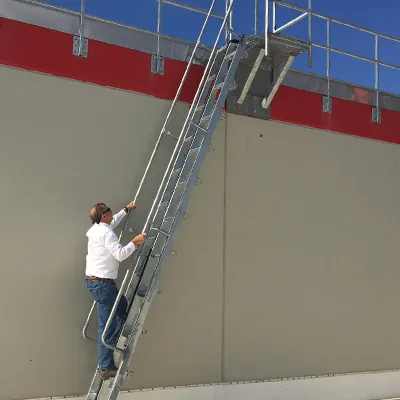
On a ladder, your hands are load-bearing. They’re not just steadying you — they’re holding you on the ladder. Lose your grip, and you lose your attachment to the structure. That’s why the rule requires a firm hold at all times and counts your hands as one of the required contact points.
On a stair, your hands are not load-bearing. Your feet carry you, the way they do on any floor or walkway. The handrail is there for balance and as a backup if you stumble, not to keep you attached to the structure. You can climb a properly designed stair with both hands full and still be stable, because stability comes from the stair’s geometry — the level treads, the moderate angle, the consistent rise — not from your grip.
So the absence of a three-point rule on stairs isn’t OSHA being lenient. It’s OSHA recognizing that a stair has engineered the stability into the structure that a ladder asks the climber to provide.
What this means for carrying tools and equipment
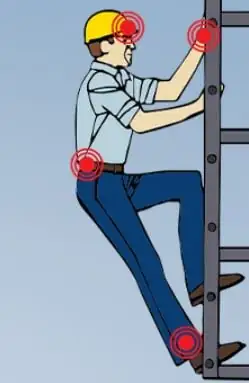
This is where the distinction stops being academic. On a ladder, three points of contact leaves you exactly one free hand, and OSHA only permits carrying an item if you can still firmly grip the ladder with that hand. Anything needing two hands forces a tool belt, a hoist, or a different way up.
On a stair, that constraint disappears. A worker can carry a tool bag, a parts bin, or an awkward component up and down without violating any climbing rule — because there’s no climbing rule to violate. For any access point that sees workers moving materials by hand, this is often the deciding factor.
The alternating tread stair: ladder footprint, stair rules
The catch has always been space. Stairs are safer and rule-light, but a conventional stair eats up a large horizontal run, and most equipment maintenance, mezzanine access, and roof-hatch locations don’t have room for one.
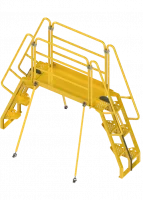
The alternating tread stair resolves that. By staggering left and right treads, it climbs at a steep 56- or 68-degree angle — close to a ladder’s pitch and footprint — while still being walked like a stair, facing forward, up and down. Because it’s classified and used as a stair, it carries the usability advantages described above: no three-point-of-contact discipline to enforce, and a free hand (or two) for whatever the job requires.
You get the compact footprint that made the ladder necessary, without inheriting the climbing constraints that limit the ladder.
The bottom line
OSHA doesn’t require three points of contact on stairs because a well-designed stair makes the rule unnecessary — stability is built in rather than enforced trip by trip. If your team is currently bound by three points of contact on a ladder, and the work involves carrying anything or making the climb often, a roof access alternating tread stair changes the equation rather than just helping people comply with it.
For the full picture on the rule itself, see Three Points of Contact: What the Rule Requires.
Wondering whether a stair can fit where you currently have a ladder? Talk to a stair expert or request a made-to-fit quote.