
When safety matters most, it’s time to reconsider the standard roof access ladder.
For decades, vertical ladders, often with cages, have been the default for rooftop access in commercial and industrial buildings. But new safety data, evolving OSHA guidance, and smarter design alternatives are changing the landscape.
If you’re planning or upgrading rooftop access, it’s worth asking:
- Is a vertical ladder still the right choice?
- And more importantly, is it your safest choice?
The Problem With Traditional Vertical Ladders
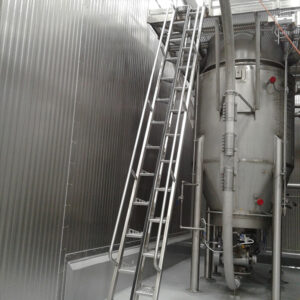
Vertical ladders are compact and familiar, but also dangerous, difficult to use, and increasingly non-compliant with modern expectations for fall protection and access design.
5 Key Issues with Caged Vertical Ladders
- False sense of security: OSHA formally discredited cages as fall protection in 2017.
- High risk of misstep: Steep vertical ascent with limited hand/foot support.
- Difficult to use: Especially for older or less agile workers, or those carrying tools.
- No support for safe egress: Emergency descent during fire, fatigue, or weather is perilous.
- Limited compliance: Many existing installations are grandfathered, but not ideal.
What OSHA Now Recommends
OSHA’s 2017 update to its Walking-Working Surfaces standard redefined expectations for ladder safety. One key change stood out:
“Employers should provide stairs for regular or routine operational use including access to equipment.”
— OSHA Standard 1910 Subpart D
This shift clearly discourages the use of fixed ladders for anything that resembles routine access or regular use. Even more importantly, OSHA eliminated the cage requirement entirely for new ladders over 24 feet—and by 2036, all existing cages must be replaced with personal fall arrest systems or ladder safety systems.
What the IBC Says About Roof Egress
If the roof isn’t just for equipment—but could ever be accessed by personnel, contractors, or used for emergency escape—you’re also subject to International Building Code (IBC) egress regulations.
Per IBC 1011.12, roof access points must include:
- Permanent stairs where necessary
- Code-compliant rise/run ratios
- Landing requirements
- Guardrails and handrails as needed
Vertical caged ladders no longer meet the functional or compliance expectations of modern roof access.
Enter the Alternating Tread Stair (ATS)
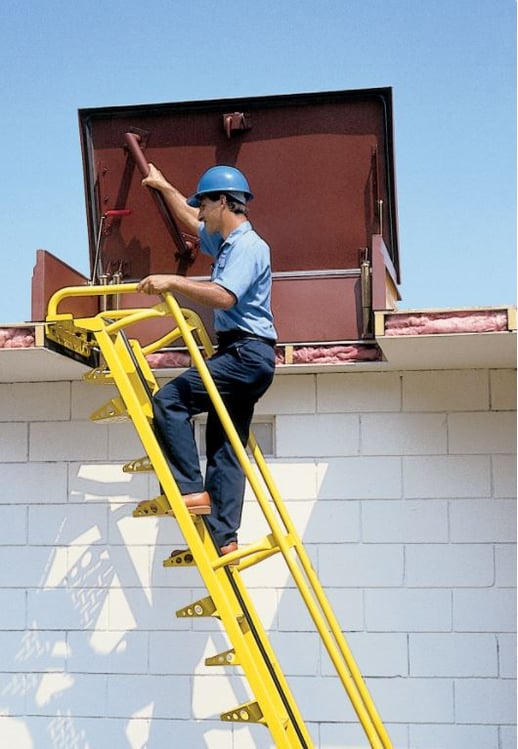
Alternating tread stairs offer a uniquely compact and safe solution, delivering steep-angle access without sacrificing foot support, user stability, or OSHA compliance.
Increased Safety Without a Cage or Harness
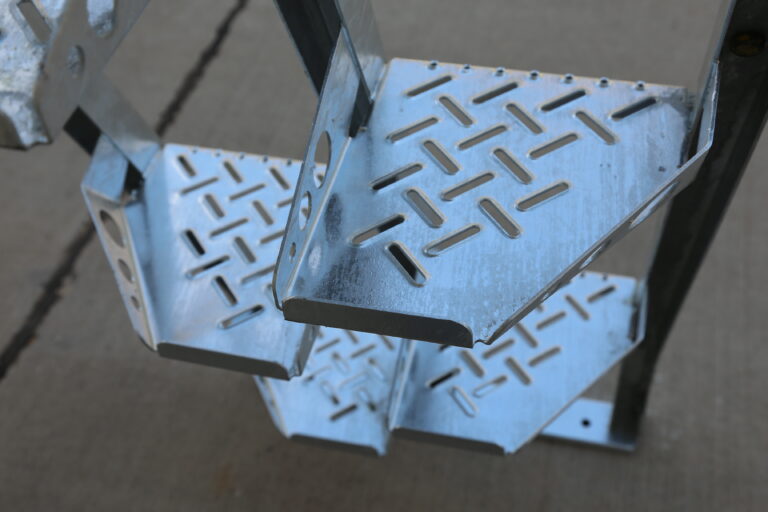
- Deep, alternating steps support the full foot with each movement.
- Users always maintain three points of contact.
- Minimal risk of misstep, even in wet or cold conditions.
- Handrails and guardrails on both sides.
Compact Footprint
ATS takes up roughly the same vertical run as a ladder, but with a much safer approach angle (typically 65° vs. 90°).
OSHA Compliant by Design
Built to meet OSHA 1910.25 and ANSI standards. No additional cage or harness required.
User-Friendly
Far easier to use than a vertical ladder and suitable for workers carrying tools or wearing PPE.
Alternating Tread Stairs vs. Caged Ladder: Side-by-Side Comparison
| Feature | Caged Ladder | ATS |
|---|---|---|
| Foot support | Minimal | Full-foot alternating treads |
| Fall protection | Cage (deprecated) | Handrails + step design |
| OSHA 2017 compliant | ❌ | ✅ |
| IBC egress alignment | Limited | Yes |
| Emergency usability | Poor | Excellent |
| Comfort/ease of use | Difficult | Moderate to easy |
| Space efficiency | High | High |
| Requires a harness? | Often | No |
| Adoption trend | Decreasing | Growing rapidly |
Where Alternating Tread Stairs Make the Most Impact
Alternating tread stairs are widely adopted in industries where roof access is essential but space, safety, and compliance are key.
- Manufacturing facilities
- Food & beverage plants
- Data centers
- Utility companies
- Distribution and warehousing
Real-World Egress Planning: How Alternating Tread Stairs Fit In
Even in unoccupied roof spaces, IBC egress codes apply. Alternating Tread Stairs offer an OSHA-compliant, code-friendly, and a safer alternative to vertical ladders.
When paired with roof hatches or modular platforms, Alternating Tread Stairs become a complete rooftop access and egress solution.
Making the Switch: Next Steps
- Evaluate your roof access frequency, space, and user profile.
- Check compliance with OSHA 1910.25 and IBC 1011.12.
- Contact Lapeyre Stair to explore Roof Access Stair models and support.
- Upgrade confidently with safer, smarter access.
Resources
- Roof Access Stairs
- ATS Product Page
- ATS Safety Features
- Unoccupied Roof Egress Requirements
- OSHA 1910.25 Regulations
- OSHA Ladder Guidelines (1926.1053)
Conclusion: A Smarter Ladder Alternative
Vertical caged ladders had their time. But that time is over.
With new OSHA guidance, growing liability risks, and safer alternatives like the Alternating Tread Stair, there’s no reason to default to outdated designs. When space is tight but safety matters, Alternating Tread Stairs offer the confidence of a stair in the footprint of a ladder.
Make the switch. Protect your people. Future-proof your facility.