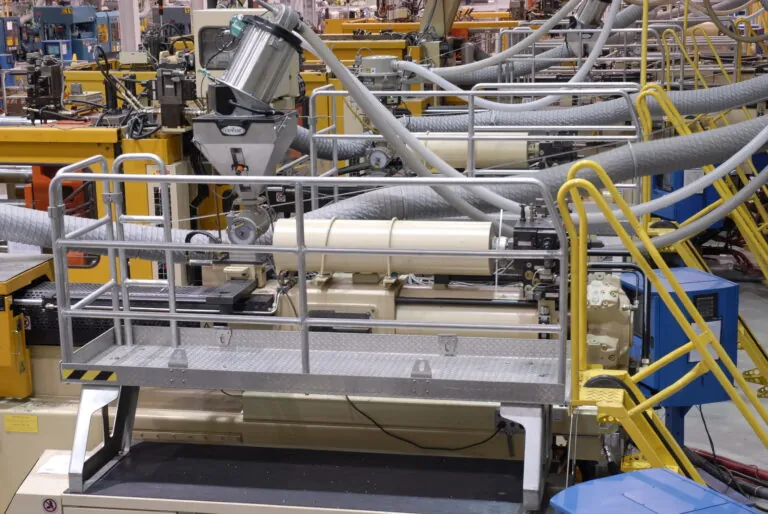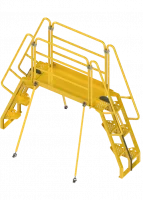

In industrial manufacturing facilities across America, safety and efficiency are paramount. One of the often overlooked yet essential components in maintaining a safe and functional workspace is the implementation of crossover stairs. These systems are not merely a convenience but a vital element in ensuring compliance with OSHA and IBC regulations, optimizing workflow, increasing safety, and enhancing operational efficiency.
Ensuring OSHA Compliance: A Necessity for Safety
The Occupational Safety and Health Administration (OSHA) sets stringent standards to safeguard workers in industrial environments. Among these, Standard 1926.10 is particularly relevant to crossover stairs. This regulation mandates that employers provide safe and accessible means of crossing over or around obstacles in the workplace.
OSHA Standard 1926.10 stipulates that passageways or walkways must be provided when necessary to ensure that employees can safely and easily navigate around or over obstructions without the risk of falling or injury. Crossover stairs are designed to meet these requirements by offering a secure and stable platform for crossing obstacles such as conveyor belts, machinery, or elevated platforms.
Ease of Use: Enhancing Workflow and Efficiency
The design of crossover stairs significantly impacts ease of use in an industrial setting. Properly constructed crossover stairs enable workers to move quickly and efficiently between different areas of the facility. This streamlined movement not only minimizes downtime but also reduces the risk of accidents caused by unsafe or cumbersome navigation.
High-quality crossover stairs are engineered with user-friendly features such as non-slip treads, sturdy handrails, and ergonomic design. These elements collectively enhance worker safety and comfort, allowing for seamless transitions across various levels of the workspace.
Simplified Installation: Reducing Downtime and Disruption
The installation of crossover stairs should be as straightforward and minimally disruptive as possible. Modern crossover stairs are designed with modular components, allowing for quicker assembly and installation. This approach minimizes operational downtime and reduces the impact on ongoing manufacturing processes.
Additionally, the ease of installation means that crossover stairs can be adapted to fit various configurations and space constraints within an industrial setting. This flexibility is crucial for facilities that require rapid modifications to accommodate changes in equipment or workflow.
Conclusion
In conclusion, the integration of crossover stair systems in industrial manufacturing spaces is not merely a matter of convenience but a critical aspect of ensuring safety and operational efficiency. Adhering to OSHA Standard 1926.10 is a fundamental requirement, and the benefits of ease of use and simplified installation further underscore their importance. By investing in high-quality crossover stairs, manufacturers can create a safer, more efficient workspace that supports both regulatory compliance and operational excellence.
For more information on selecting and installing crossover stairs, or to discuss your facility’s specific needs, please contact our team of experts. Ensuring your workplace meets safety standards and operates smoothly is our top priority.