Ship ladders (also called ship stairs) and alternating tread stairs are both steep stair devices installed at 50 to 70 degrees from horizontal for spaces too tight for a standard stair. The key difference is tread depth: OSHA allows ship stair treads as shallow as 4 inches, while alternating tread stairs alternate half-width treads so each foot gets at least 8.5 inches. Both require handrails on both sides, and OSHA permits either one only when a standard stair isn’t feasible.
Alternating tread stairs, ships ladders, and ship stairs are all steep angled stair devices used in space-restricted applications. OSHA and IBC define and set standards for each design. This guide explains those standards and helps you choose the safest, code-compliant option.
Table of contents
- Types of ship ladders & stairs (& design specifications)
- Alternating tread ships ladder design specifications
- What are alternating tread ships ladders?
- OSHA alternating tread ships ladder standards
- IBC alternating tread ships ladder code requirements
- Ships ladder design specifications
- What are ship ladders?
- OSHA ships ladder standards
- IBC ships ladder code requirements
- Ship stairs design guidelines
- What are ship stairs?
- OSHA ship stairs standards
- IBC ship stairs code requirements
- Ship stairs & ladders: Which is the right choice for you?
- Alternating tread device vs ships ladder
- FAQ
Types of ship ladders & stairs (& design specifications)
The two most common steep stair devices for space-constrained applications are alternating tread stairs and ship stairs (ships ladders). OSHA Section 1910.21(b) defines both:
- Ship stair (ship ladder)
- A stairway that is equipped with treads, stair rails, and open risers, and has a slope that is between 50 and 70 degrees from the horizontal.
- Alternating tread-type stair
- A type of stairway consisting of a series of treads that usually are attached to a center support in an alternating manner such that an employee typically does not have both feet on the same level while using the stairway.
Ship stair vs alternating tread stair at a glance
| Requirement | Ship stair / ships ladder | Alternating tread stair |
|---|---|---|
| Angle from horizontal | 50–70° | 50–70° |
| OSHA minimum tread depth | 4″ | 8.5″ |
| OSHA width | 18″ minimum tread width | 7″ minimum tread width; 17–24″ between handrails |
| IBC treads and risers | 5″ minimum tread depth, 8½” minimum projected tread depth, 9½” maximum riser | 5″ minimum tread depth, 8½” minimum projected tread depth, 9½” maximum riser |
| Handrails | Both sides | Both sides |
| Typical descent | Usually backing down, facing the device | Face-forward, like a standard stair |
| IBC means of egress | Group I-3 control rooms or observation stations up to 250 sq ft with no more than 3 occupants; access to unoccupied roofs | Group F, H and S mezzanines up to 250 sq ft serving no more than 5 occupants; Group I-3 guard towers, observation stations or control rooms up to 250 sq ft; access to unoccupied roofs |
| Sources: OSHA 1910.25 and 1910.28; IBC 1011.14 and 1011.15, as quoted in this guide. | ||
Alternating tread ships ladder design specifications
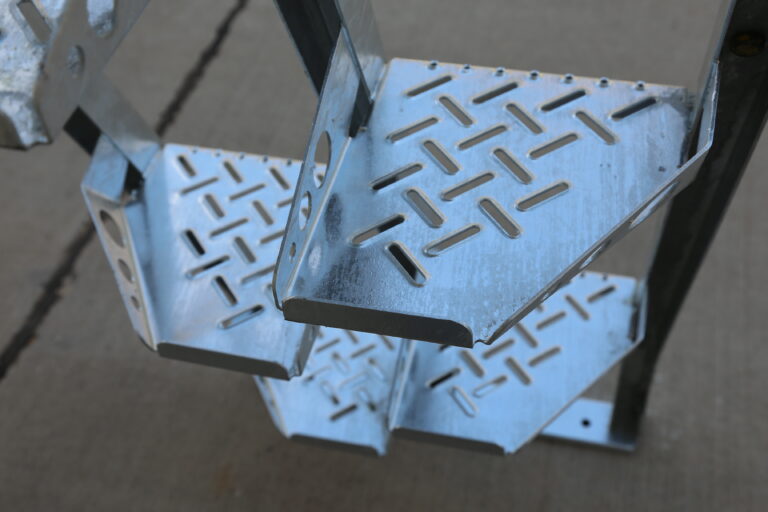
Alternating tread stairs use a staggered step design that increases usable tread depth at steep angles, which allows a safer, face-forward descent. Here is how each foot uses the tread on three stair types:

Standard stair: each foot normally uses only about half of each tread, stepping out and over the unused section.

Ship stair: the unused half tread becomes an obstacle by reducing the usable depth of the tread below.
Alternating tread stair: the unused half tread is removed to provide more tread depth for improved safety and comfort.
The increased tread depth gives the user a complete surface for each step.
What are alternating tread ships ladders?
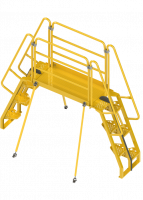
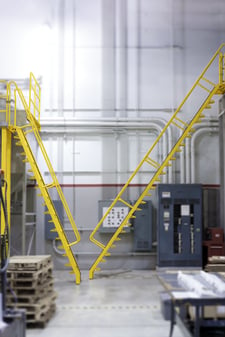
 Alternating tread stairs are a type of ships ladder or ship stair device used to save floor space where a standard stair won’t fit. Typical applications include conveyor and equipment access, work platforms, crossover stairs, and anywhere in a facility without space for a standard stair design.
OSHA and the IBC define the device as follows:
- Alternating tread-type stair (OSHA)
- A type of stairway consisting of a series of treads that usually are attached to a center support in an alternating manner such that an employee typically does not have both feet on the same level while using the stairway.
- Alternating tread device (2018 International Building Code)
- A device that has a series of steps between 50 and 70 degrees from horizontal, usually attached to a center support rail in an alternating manner so that the user does not have both feet on the same level at the same time.
OSHA alternating tread ships ladder standards
OSHA 1910.25(f) requires alternating tread stairs to be installed at 50 to 70 degrees, with 17 to 24 inches between handrails, a minimum 8.5-inch tread depth and a minimum 7-inch tread width:
- 1910.25(f)(1) Have a series of treads installed at a slope of 50 to 70 degrees from the horizontal;
- 1910.25(f)(2) Have a distance between handrails of 17 to 24 inches (51 to 61 cm);
- 1910.25(f)(3) Have a minimum tread depth of 8.5 inches (22 cm); and
- 1910.25(f)(4) Have open risers if the tread depth is less than 9.5 inches (24 cm);
- 1910.25(f)(5) Have a minimum tread width of 7 inches (18 cm), measured at the leading edge of the tread (i.e., nosing).
OSHA 1910.28 also requires that alternating tread stairs and ship stairs have handrails:
1910.28(b)(11)(iii) Each ship stairs and alternating tread type stairs is equipped with handrails on both sides.
The side-mounted handrails also act as the guardrail fall protection for the device. Because they have an integrated side-mounted hand / guardrail, alternating tread stairs do not need to be used with fall arrest systems.
OSHA also limits when employers can use an alternating tread stair:
OSHA §1910.25(b)(8) Spiral, ship, or alternating tread-type stairs are used only when the employer can demonstrate that it is not feasible to provide standard stairs.
Usually, alternating tread stairs or ship stairs are used when space restrictions make it not feasible to provide standard stairs.
Because alternating tread stairs have a full usable tread surface for each foot, they are designed to be descended face-forward like a standard stair. They are not subject to the OSHA 1910.23 ladder requirement to face the ladder (back down) while climbing. The face-forward descent lets users see in the direction of travel and more easily carry tools or items while descending.
IBC alternating tread ships ladder code requirements
IBC section 1011.14.2 requires alternating tread devices to have a minimum 5-inch tread depth, an 8½-inch minimum projected tread depth, a 7-inch minimum tread width and a 9½-inch maximum riser height:
Alternating tread devices shall have a minimum tread depth of 5 inches, a minimum projected tread depth of 8 1/2″, a minimum tread width of 7 inches, and a maximum riser height of 9 1/2.” The tread shall be measured horizontally between the vertical planes of the foremost projections of the adjacent treads. The riser height shall be measured vertically between the leading edges of adjacent treads. The riser height and tread depth shall result in an angle of ascent from the horizontal of between 50 and 70 degrees.
IBC also strictly limits how alternating tread stairs can be used as a means of egress. IBC Section 1011.14 states that alternating tread devices are limited to an element of a means of egress in buildings of Groups F, H, and S from a mezzanine not more than 250 square feet in area and that serves not more than five occupants; in buildings of Group I-3 from a guard tower, observation station or control room not more than 250 square feet in area; and for access to unoccupied roofs.
IBC also allows an exception to IBC 1011.12 so that access to the roof from the top story is permitted to be by an alternating tread device, a ships ladder, or a permanent ladder. The exception to IBC 1011.12.2 also allows access to unoccupied roofs to be a roof hatch or trap door.
So for unoccupied roofs, a ladder or alternating tread stair extending through a roof hatch is the most common method of accessing the roof.
Ships ladder design specifications
Ships ladders are steep angled stair devices with angles between 50 and 70 degrees. This is much steeper than the typical angle of stairs of 45 degrees per OSHA and 30-32 degrees per IBC. Because they are so steep, ships ladders have much less usable tread depth than a standard OSHA or IBC stair design.

What are ship ladders?
A ship ladder is a very steep stair, set at 50 to 70 degrees, with treads, stair rails and open risers. Ship stairs and ship ladders are addressed by both OSHA and IBC. OSHA uses the terms ship stair and ship ladder interchangeably, while IBC uses the term ships ladder. OSHA requires that all ladders between 60 and 90 degrees be device-facing, so any ships ladder angled 60 degrees or steeper must be descended backing down.
OSHA defines a ship stair in section 1910.21(b) as:
A stair that is equipped with treads, stair rails, and open risers, and has a slope that is between 50 and 70 degrees from the horizontal.
This figure from OSHA 1910.25 – Stairways shows two ship stairs at different angles.

OSHA Figure D-9: ship stairs at two different angles.
White paper: Download “Safety of alternating tread stairs vs ship stairs”
OSHA ships ladder standards
OSHA 1910.25(e) requires ship stairs to be installed at 50 to 70 degrees, with open risers of 6.5 to 12 inches, a minimum 4-inch tread depth and a minimum 18-inch tread width. In addition to paragraph (b) of section 1910.25, the employer must ensure ship stairs (see Figure D-9 of that section):
- 1910.25(e)(1) Are installed at a slope of 50 to 70 degrees from the horizontal;
- 1910.25(e)(2) Have open risers with a vertical rise between tread surfaces of 6.5 to 12 inches (17 to 30 cm);
- 1910.25(e)(3) Have minimum tread depth of 4 inches (10 cm); and
- 1910.25(e)(4) Have a minimum tread width of 18 inches (46 cm).
OSHA also defines angles for each type of stairway and ladder:
| Angle from horizontal | Type |
|---|---|
| ≤ 30° | Ramp |
| 30°–50° | Standard stairs |
| 50°–70° | Ship stairs |
| 50°–70° | Alternating tread-type stairs |
| 60°–90° | Ladders |
Like the alternating tread stair, ship stairs must have handrails under OSHA 1910.28:
1910.28(b)(11)(iii) Each ship stairs and alternating tread type stairs is equipped with handrails on both sides.
The side-mounted handrails also act as the guardrail fall protection for the device. Because they have an integrated side-mounted hand / guardrail, ships ladders do not need to be used with fall arrest systems.
OSHA also limits when employers can use ships ladders:
OSHA §1910.25(b)(8) Spiral, ship, or alternating tread-type stairs are used only when the employer can demonstrate that it is not feasible to provide standard stairs.
Since ships ladders have a very narrow tread surface, they must typically be descended backwards like a vertical ladder. When backing down a ladder, OSHA requires that users use at least one hand for grasping and do not carry tools or items that can cause loss of balance:
- 1910.23(b)(12) Each employee uses at least one hand to grasp the ladder when climbing up and down it; and
- 1910.23(b)(13) No employee carries any object or load that could cause the employee to lose balance and fall while climbing up or down the ladder.
IBC ships ladder code requirements
IBC section 1011.15 requires handrails on both sides of a ships ladder, at least 20 inches of clear width at and below the handrails, a minimum 5-inch tread depth (8½ inches including nosing projection) and a maximum 9½-inch riser.
1011.15.1 Handrails of ships ladders
Handrails shall be provided on both sides of ships ladders.
Per 1011.15, the minimum clear width at and below the handrails shall be 20 inches.
1011.15.2 Treads of ships ladders
Ships ladders shall have a minimum tread depth of 5 inches (127mm). The tread shall be projected such that the total of the tread depth plus the nosing projection is not less than 8 1/2 inches (216mm). The maximum riser height shall be 9 ½ inches (241 mm).
IBC also strictly limits how ships ladders can be used as a means of egress. IBC section 1011.15 states that ships ladders are permitted in Group I-3 as a component of a means of egress to and from control rooms or elevated facility observation stations not more than 250 square feet with not more than three occupants, and for access to unoccupied roofs.
Ship stairs design guidelines
Ship stairs and ship ladders (or ships ladders) are the same type of device, and the design requirements are the same no matter the terminology. OSHA uses the term ship stair, while IBC uses the term ships ladder.
What are ship stairs?
Ship stairs are steep stairs of 50 to 70 degrees, the same device OSHA also calls a ship ladder.
What is the difference between a ship stair and a ship ladder?
The difference is in how the device is used: OSHA requires ladders to be climbed facing the ladder, while stairs, ship stairs and alternating tread stairs are not subject to that rule. OSHA 1910.23 sets these requirements for employees using ladders:
- 1910.23(b)(11) Each employee faces the ladder when climbing up or down it;
- 1910.23(b)(12) Each employee uses at least one hand to grasp the ladder when climbing up and down it; and
- 1910.23(b)(13) No employee carries any object or load that could cause the employee to lose balance and fall while climbing up or down the ladder.
Stairways and alternating tread stairs can both be descended face forward in the direction of travel. Some ship stairs can be descended face forward, depending on how steep the angle is. The angles of ship stairs and ladders overlap between 60 and 70 degrees: ship stairs can be as steep as 70 degrees, while ladders can be as shallow as 60 degrees.
Ship stairs shallower than 60 degrees can be designed as face-forward descent devices. However, because these devices have much shorter tread depth, walking down face-forward is very difficult and potentially unsafe. Users are left with a very small tread surface for each foot, causing a fall hazard, as this photo shows.

In many cases, backing down ship stairs is a safer alternative even though the user cannot see where they are going.
When backing down ships ladders, employees should follow the same OSHA rules as for descending fixed ladders: use at least one hand to grasp the ladder and do not carry objects while climbing.
How ship stairs or ship ladders are designed to be descended is up to the designer or operator. Designers should consider that as stairs get steeper, tread depth shortens and becomes a major risk factor of stairway design. For standard ship stairs, a shallower angle is safer than a steep angle. Alternating tread stairs have the unused half of each tread removed to provide more tread depth at steeper angles.
For more info, download our guide on stair design for safety and ergonomics.
OSHA ship stairs standards
The OSHA standards for ship stairs are the same as for ship ladders, because OSHA uses the two terms interchangeably.
IBC ship stairs code requirements
The IBC code requirements for ship stairs are the same as for ships ladders. IBC uses the term ships ladder and does not use the term ship stair anywhere in the code.
Ship stairs & ladders: Which is the right choice for you?
Choose based on safety: when a standard stair won’t fit, an alternating tread stair gives more tread depth than a ship stair at the same angle.
It helps to understand a few of the most important design-induced safety factors of stairway design, as outlined in Chapter 13 of Fall Protection and Prevention: Principles, Guidelines, and Practices:
- As tread depth becomes narrower than a foot length, missteps become more frequent. Shorter treads give insufficient foot support and cause postural instabilities.
- There may be no graspable, reachable handrail.
- There may be a discontinuous handrail.
- There may be confusing color patterns on the tread or poor visibility of nosings.
- The nosing strip may project above the tread.
Of these safety factors, adequate stair tread depth varies the most between stair designs. Standard stairs have the most tread depth, followed by alternating tread stairs, spiral stairs, then ship stairs.
| Stair type | OSHA | IBC |
|---|---|---|
| Standard stairs | 9.5″ | 11″ |
| Alternating tread stairs | 8.5″ | 8.5″ |
| Spiral stairs | 7.5″ | 7.5″ |
| Ship stairs | 4″ | 5″ |
Alternating tread device vs ships ladder
Alternating tread stairs are safer than ship stairs in published studies, mainly because of their deeper treads.
Many studies have shown that narrow tread depth is a risk factor for stairways. One study, by Hisao Nagato of the Ohara Memorial Institute for Science of Labor in Japan, measured how difficult users found it to descend stairways with varying tread depths. Stairs became increasingly difficult to descend as tread depth narrowed. The researchers measured difficulty with a Z-value, which increases as difficulty increases. Ship stairs showed very high perceived difficulty in descent due to their short tread depth.
| Stair type | Z-value |
|---|---|
| IBC stairs | 12 |
| Standard OSHA stairs | 146 |
| Alternating tread stairs | 182 |
| Spiral stairs | 231 |
| Ship stairs | 505 |
| Source: Hisao Nagato, Ohara Memorial Institute for Science of Labor. | |
Another study, by the Virginia Tech Human Factors Engineering Laboratory, found that ship stairs produced 72% more missteps than alternating tread stairs. Participants preferred alternating tread stairs and rated them higher for both safety and comfort.
| Finding | Result |
|---|---|
| Chose alternating tread stair for safer tread depth | 89% |
| Chose alternating tread stair for more comfortable tread depth | 85% |
| Chose alternating tread stair for safer ascent | 72% |
| Chose alternating tread stair for more comfortable ascent | 89% |
| Chose alternating tread stair for safer descent | 82% |
| Chose alternating tread stair for more comfortable descent | 85% |
| More overall missteps on the ship stair | 72% |
| More missteps on the ship stair when descending with a load | 129% |
| Felt more likely to slip or trip on ship stair ascent | 64% |
| Felt more likely to slip or trip on ship stair descent | 85% |
| Source: Department of Industrial Engineering, Virginia Polytechnic Institute; proceedings of the Human Factors Society 32nd Annual Meeting, pp. 981–984. | |
Conclusion
The results are clear. The alternating tread stair is the safer, more comfortable option when it comes to space-saving stairs. If you have limited space and need a steep stair, choose the alternating tread stair.
FAQ
What angle is a ship ladder?
A ship ladder angle is between 50 and 70 degrees. OSHA section 1910.25(e)(1) requires ship ladders to be installed at a slope of 50 to 70 degrees from the horizontal.
What is an alternating tread staircase?
An alternating tread staircase is a type of steep, safety stair with a staggered step design. Alternating tread stairs have steep angles to save space. The staggered step design increases the usable tread depth to provide the user a full tread surface on each step.
Are alternating tread stairs legal?
Alternating tread stairs are legal to install and use in space-restricted areas under OSHA section 1910.25. Alternating tread-type stairs are used only when the employer can demonstrate that it is not feasible to provide standard stairs.