Aluminum has become a favorite material for industrial access equipment for a simple reason: it delivers real structural strength at a fraction of the weight of steel. Here’s how aluminum earned its place in industrial fabrication, what makes it perform the way it does, and where it fits best in metal stair applications.
A Brief History of Aluminum in Industrial Use
Aluminum is the most abundant metal in the earth’s crust, but for most of the 19th century it was harder to refine than gold — extracting it from ore required an expensive, labor-intensive chemical process. That changed in 1886, when the Hall-Héroult process was developed independently by Charles Martin Hall in the United States and Paul Héroult in France. This electrolytic smelting method made aluminum production commercially viable for the first time, and prices dropped dramatically over the following decades.
Aluminum’s industrial breakout came through aviation. Its light weight and decent strength made it the material of choice for aircraft manufacturing through both World Wars, and the massive wartime production infrastructure that followed left behind both a mature aluminum industry and decades of engineering knowledge about how to work with it. By the mid-20th century, that knowledge moved into general industrial and construction use, where aluminum’s light weight and natural corrosion resistance made it a practical alternative to steel for equipment access, platforms, and modular structures — especially in applications where weight, corrosion, or frequent reconfiguration were a concern.
Features of Aluminum
- Lightweight strength. Aluminum weighs roughly a third as much as steel by volume, while still offering solid structural performance for stairs, platforms, and crossover systems.
- Natural corrosion resistance. Aluminum forms a thin, stable oxide layer on its surface almost immediately on exposure to air, which protects the metal underneath from further corrosion — without any coating required.
- Non-sparking properties. Aluminum is less likely to generate sparks on impact compared to steel, a relevant consideration in certain hazardous or combustible-dust environments.
- No rust. Because aluminum doesn’t contain iron, it can’t rust the way carbon steel does, even with the coating removed or scratched.
- Easier handling and installation. The reduced weight makes aluminum components significantly easier to maneuver, lift, and install without heavy equipment.
Benefits for Metal Stair Applications
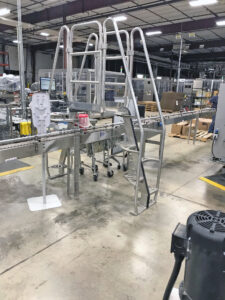
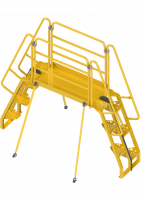
aluminum alternating tread crossover stairs
Faster, easier installation. Lighter components mean crews can often install aluminum stairs and platforms with fewer people and less equipment than comparable steel structures.
Corrosion resistance without extra coatings. In many environments, aluminum doesn’t need galvanizing or powder coating to resist rust and degradation, which can simplify maintenance planning.
Reduced structural load. Because aluminum is so much lighter than steel, it places less stress on the building, equipment, or foundation it’s mounted to — a meaningful consideration for rooftop or equipment-mounted applications.
Well suited to frequent reconfiguration. Facilities that regularly rearrange equipment or production lines benefit from aluminum’s lighter weight when platforms or crossovers need to be relocated.
Where Aluminum Makes the Most Sense
Aluminum is a strong fit for rooftop access, equipment platforms, and applications where weight matters — whether that’s because of building load limits, ease of installation, or the need to move a structure down the road. It performs well in food and beverage, chemical, and general manufacturing settings where corrosion resistance is needed without the added weight or cost of stainless steel.
Lapeyre Stair manufactures pre-engineered metal stairs, platforms, and crossover systems in aluminum, carbon steel, and stainless steel — built to your specifications and ready to install. Talk to a stair expert about the right material for your application.