“Maintain three points of contact” is one of the most repeated lines in workplace safety — printed on ladder rails, built into every toolbox talk, recited until it fades into background noise. But the phrase carries more precision than most people give it credit for. It has a specific definition, a specific regulatory home, and a specific set of conditions that make it possible or impossible. This post pins all three down.
The definition
Three points of contact means keeping either two hands and one foot, or two feet and one hand in firm contact with the ladder at all times while climbing up or down. Three is the minimum; only one limb moves at a time while the other three stay put.
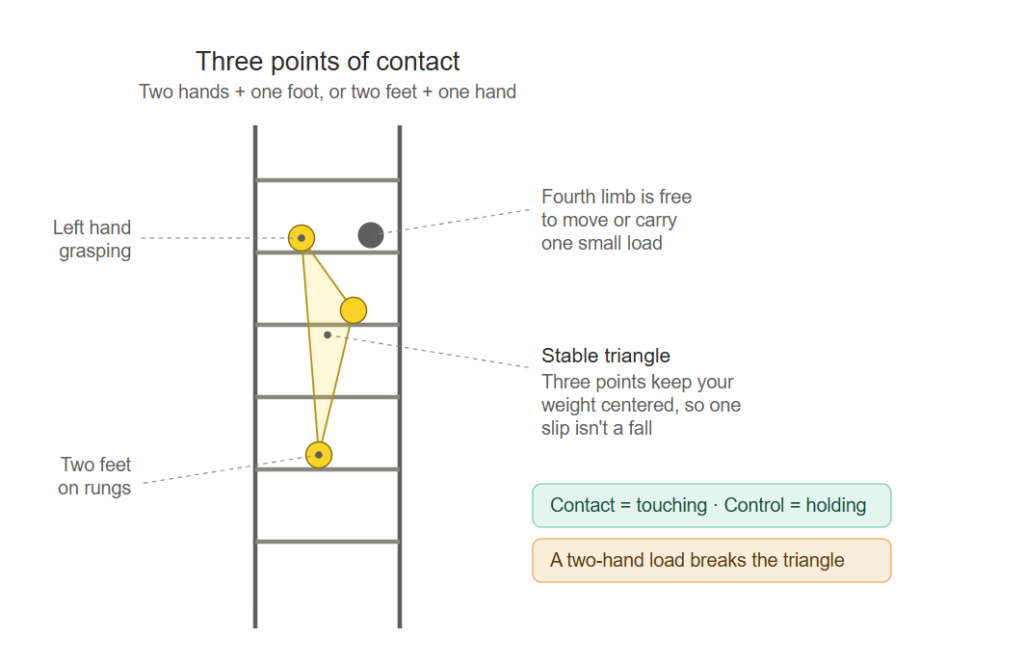
The reason it’s three and not two is geometry. Three contact points form a triangle, and a triangle is stable — your center of gravity stays inside the base of support, so a single slip doesn’t become a fall. Two points form a line, and a body balanced on a line tips. The smaller and more compact that triangle, the more stable you are, which is why OSHA wants your body centered between the side rails rather than reaching outside them.
A subtle but important reframing: OSHA’s interpretation letters refer to this as three points of control, not just contact. Touching the ladder isn’t the standard. Staying in control of your position on it is. A fingertip grazing a rail is contact; it is not control.
The regulation
For general industry, three points of contact lives in 29 CFR 1910.23(b), specifically subsections (11), (12), and (13). The standard requires employers to ensure that each employee:
- Faces the ladder when climbing up or down it — 1910.23(b)(11)
- Uses at least one hand to grasp the ladder when climbing up and down it — 1910.23(b)(12)
- Does not carry any object or load that could cause them to lose balance and fall — 1910.23(b)(13)
Read together, those three subsections are the three-points-of-contact rule. OSHA states in the preamble to the Subpart D final rule that their intent is for employers to ensure workers maintain three-point contact with the ladder at all times while climbing. For construction, the parallel requirements appear in 1926.1053.
Two specifics that get lost in casual retellings:
You must face the ladder in both directions. Before 2017, an older consensus standard permitted forward-facing descent (climbing down facing away) on equipment pitched at 50 degrees or less. When OSHA revised its regulatory text, it did not carry that allowance forward. So on a fixed ladder, you descend backward, facing the ladder, regardless of its angle.
“Grasp” means a firm hold, not a slide. 1910.23(b)(12) requires at least one hand to firmly grasp the ladder. The sliding-hand technique — letting a loose palm trail down the rail as you descend — does not satisfy the rule. OSHA doesn’t mandate gripping the rungs specifically versus the side rails, but it does require a genuine, controlling hold.
The condition that makes or breaks it
Here is where the rule turns concrete. Climbing already commits three of your four limbs to the ladder. That leaves exactly one hand for anything else — including whatever you’re carrying.
OSHA does not flatly prohibit carrying an item up a ladder. But the permission is narrow: the object’s size and shape must allow you to keep a firm grip on the ladder with that same hand throughout the climb. The instant a load needs two hands, or is bulky enough to pull you off balance, three points of contact becomes physically impossible.
When that happens, OSHA’s guidance points to two options: change the material-handling method (a tool belt, a backpack, a hoist or hand line to raise tools separately), or change the means of access. The rule, in other words, doesn’t just tell you how to climb — it tells you when a ladder has stopped being the right tool.
Where stairs sit relative to the rule
Three points of contact is fundamentally a ladder discipline. It exists because a ladder demands that your hands do structural work — they’re load-bearing, not just steadying. That’s the whole reason a free hand for tools is so scarce.
An alternating tread stair removes that demand. You walk it facing forward, up and down, with your feet carrying you and a continuous handrail there for balance rather than support. The stability the three-points rule works so hard to enforce on a ladder is simply built into how a stair is used.
The practical upshot for facility and safety managers: where ladders are in use, three points of contact should be trained and enforced without exception. But if your team is routinely breaking it — climbing one-handed with a load, sliding a grip on the way down — that’s not first a training failure. It’s a signal that the access method is mismatched to the work being done on it.
We unpack that mismatch, and where different access systems land on the safety hierarchy, in Roof Access Ladders: Why Vertical Caged Ladders Are Falling Behind and Fall Protection Systems Ranked: From Minimum Compliance to Maximum Safety.
Have an access point where three points of contact keeps breaking down? Talk to a stair expert or request a made-to-fit quote.