
The maximum stair riser height and minimum stair tread depth depend on the stair type and the governing code. For standard stairs, OSHA allows a riser of up to 9.5 inches with a tread of at least 9.5 inches, while the IBC allows a riser of up to 7 inches with a tread of at least 11 inches. Understanding the OSHA stair requirements as well as the IBC stair requirements can help ensure your stairs are safe and in compliance.
Stair tread depth and riser height definitions
Tread depth is the horizontal distance a user’s foot can rest on, and riser height is the vertical distance between adjacent treads. Both terms, along with minimum tread depth and maximum riser height requirements, are defined by OSHA and IBC.
Stair tread depth definition
Stair tread depth is measured horizontally between the foremost projections (nosings) of adjacent treads. The stair tread depth code is defined in OSHA sections 1910.21 and 1910.25 and in IBC Chapter 10, Means of Egress.
Under OSHA 1910.21, a stair tread is a horizontal member of a stair or stairway, but does not include landings or platforms.
IBC 2018 states that “tread depth is measured horizontally between the vertical planes of the foremost projection of adjacent treads and at a right angle to the tread’s leading edge.” It is a measure of the surface available for the user’s foot to rest on as they ascend or descend the stair.

Tread depth is measured horizontally from nosing to nosing.
Stair riser height definition
Stair riser height is the vertical distance between the nosings (leading edges) of adjacent treads. The stair riser height code is also defined in OSHA sections 1910.21 and 1910.25 and in IBC Chapter 10, Means of Egress.
OSHA 1910.21 defines a stair riser as the upright (vertical) or inclined member of a stair that is located at the back of a stair tread or platform and connects close to the front edge of the next higher tread, platform, or landing.
According to IBC 1011.5.2, the riser height is measured vertically between the nosings (the leading edge) of adjacent treads.

Riser height is measured vertically between tread nosings.
Minimum stair tread depth
The minimum stair tread depth ranges from 4 inches for OSHA ship stairs to 11 inches for IBC standard stairs. OSHA and IBC have different tread depth requirements for different stair types. OSHA introduced minimum tread depths in its 2017 update to the walking-working surfaces standards, while IBC has required a minimum tread depth for many years.
OSHA and IBC set minimum tread depths and maximum riser heights based on research on stairways with various tread and riser dimensions. One important study by John Templer in 1976 showed that reducing tread depth to less than about 11 inches resulted in more missteps. Other studies have shown that missteps increase as tread depth narrows. Based on these results and others, the major building codes adopted standards for minimum tread depth and riser heights.
Standard stair tread depth requirements
Standard stairs need a minimum tread depth of 9.5 inches under OSHA and 11 inches under IBC (10 inches in most residential dwelling units). Under OSHA, a standard stair means a fixed or permanently installed stairway that is not an alternating tread stair, ship stair, or spiral stair.
OSHA 1910.25(c)(3) requires standard stairs to have a minimum tread depth of 9.5 inches (24 cm).
IBC 1011.5.2 requires stair treads to be 11 inches (279 mm) minimum, measured horizontally between the vertical planes of the foremost projection of adjacent treads and at a right angle to the tread’s leading edge.
In Group R-3 occupancies, within dwelling units in R-2 occupancies, and within Group U occupancies that are accessory to Group R-3 occupancies or to individual dwelling units within R-2 occupancies, the minimum tread depth is 10 inches. This 10-inch minimum applies to most permanent residential occupancies with multiple dwelling units.
Alternating tread stair tread depth requirements
Alternating tread stairs need a minimum tread depth of 8.5 inches under both OSHA and IBC. Alternating tread stairs are steep stairs used to access tight spaces. OSHA defines an alternating tread-type stair as a type of stairway consisting of a series of treads that usually are attached to a center support in an alternating manner, such that an employee typically does not have both feet on the same level while using the stairway.
OSHA 1910.25(f)(3) requires alternating tread stairs to have a minimum tread depth of 8.5 inches (22 cm).
IBC 1011.14.2 requires alternating tread devices to have a minimum projected tread depth of 8.5 inches (216 mm).
Ship ladder tread depth requirements
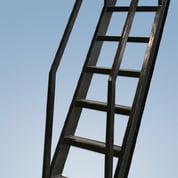
Ship stair with open risers.
OSHA 1910.25(e)(3) requires ship stairs to have a minimum tread depth of 4 inches (10 cm).
IBC 1011.15.2 requires ships ladders to have a minimum tread depth of 5 inches (127 mm).
Spiral stair tread depth requirements
Spiral stairs need a minimum tread depth of 7.5 inches under OSHA and 6 3/4 inches under IBC, measured 12 inches from the narrow edge. OSHA defines a spiral stair as a series of treads attached to a vertical pole in a winding fashion, usually within a cylindrical space.
OSHA 1910.25(d)(4) requires spiral stairs to have a minimum tread depth of 7.5 inches (19 cm), measured at a point 12 inches (30 cm) from the narrower edge.
IBC 1011.10 requires spiral stairways to have a 6 3/4 inch (171 mm) minimum clear tread depth at a point 12 inches (305 mm) from the narrow edge.
Minimum stair tread depth chart
| Stair type | OSHA minimum tread depth | IBC minimum tread depth |
|---|---|---|
| Standard stairs | 9.5″ (1910.25(c)(3)) | 11″ (1011.5.2); 10″ in R-3 and R-2 dwelling units |
| Alternating tread stairs | 8.5″ (1910.25(f)(3)) | 8.5″ (1011.14.2) |
| Spiral stairs | 7.5″ at 12″ from narrow edge (1910.25(d)(4)) | 6.75″ at 12″ from narrow edge (1011.10) |
| Ship stairs | 4″ (1910.25(e)(3)) | 5″ (1011.15.2) |
Tread depths vary considerably between stair types. Research shows that adequate tread depth is a major safety factor for stairways. You can see the difference tread depth makes when descending an alternating tread stair with an 8.5″ tread depth compared to a steep stair with a 4″ tread depth.
Maximum stair riser height
The maximum stair riser height ranges from 7 inches for IBC standard stairs to 12 inches for OSHA ship stairs. OSHA and IBC have different maximum riser height requirements depending on the type of stairway.
Standard stair riser height requirements
Standard stairs may have a maximum riser height of 9.5 inches under OSHA and 7 inches under IBC (7 3/4 inches in most residential dwelling units).
OSHA 1910.25(c)(2) requires standard stairs to have a maximum riser height of 9.5 inches (24 cm).
IBC 1011.5.2 requires stair riser heights to be 7 inches (178 mm) maximum and 4 inches (102 mm) minimum.
In Group R-3 occupancies, within dwelling units in R-2 occupancies, and within Group U occupancies that are accessory to Group R-3 occupancies or to individual dwelling units within R-2 occupancies, the maximum riser height is 7 3/4 inches. This 7 3/4-inch maximum applies to most permanent residential occupancies with multiple dwelling units.
Alternating tread stair riser height requirements
IBC limits alternating tread stair risers to 9.5 inches, while OSHA sets no specific maximum riser height. Instead, OSHA requires alternating tread stairs to have a series of treads installed at a slope of 50 to 70 degrees from the horizontal and a minimum tread depth of 8.5 inches (22 cm). If the tread depth is less than 9.5″, alternating tread stairs must have open risers.
IBC 1011.14.2 requires alternating tread devices to have a maximum riser height of 9 1/2″ (241 mm).
Spiral stair riser height requirements
Spiral stairs may have a maximum riser height of 9.5 inches under both OSHA and IBC.
OSHA 1910.25(d)(2) requires spiral stairs to have a maximum riser height of 9.5 inches (24 cm).
IBC 1011.10 requires that spiral stair riser height be not more than 9 1/2 inches (241 mm). The risers must be sufficient to provide a headroom clearance of 78 inches (1981 mm) minimum.
Ship ladder riser height requirements
Ship stairs may have a riser of up to 12 inches under OSHA and up to 9.5 inches under IBC.
OSHA 1910.25(e)(2) requires ship stairs to have open risers with a vertical rise between tread surfaces of 6.5 to 12 inches (17 to 30 cm).
IBC 1011.15.2 requires ships ladders to have a maximum riser height of 9 1/2″ (241 mm).
Maximum stair riser height chart
| Stair type | OSHA maximum riser height | IBC maximum riser height |
|---|---|---|
| Standard stairs | 9.5″ (1910.25(c)(2)) | 7″ (1011.5.2); 7 3/4″ in R-3 and R-2 dwelling units |
| Alternating tread stairs | Not specified (50°–70° slope required) | 9.5″ (1011.14.2) |
| Spiral stairs | 9.5″ (1910.25(d)(2)) | 9.5″ (1011.10) |
| Ship stairs | 12″ (6.5″–12″ range, 1910.25(e)(2)) | 9.5″ (1011.15.2) |
Choosing tread depth and riser height
Maximize tread depth wherever space allows: aim for close to 11″ on standard stairs, and use alternating tread stairs rather than ship stairs where space is tight. The charts show that minimum tread depth and maximum riser height vary greatly between stair types. Tread and riser dimensions depend on the standard stair angle. Generally, steeper stairs, like ship stairs or ships ladders, have less tread depth, because as a stair gets steeper the tread above becomes an obstacle to the tread below.

Alternating tread stairs offer more usable tread depth than ship stairs.
OSHA introduced its own minimums for tread depth and riser height in the 2017 update to walking-working surfaces. Based on the stair codes and safety research, we recommend:
- Designing stairs to maximize stair tread depth as much as possible.
- For applications without space restrictions, choosing standard stairs with as close as possible to an 11″ tread depth.
- For space-restricted applications, choosing alternating tread stairs, which have more than 2x the usable tread depth of ship stairs.
FAQs on stair riser height and stair tread depth codes
What is the standard stair tread and riser?
The standard stair tread is the horizontal member of a stair that serves as the walking surface. The standard riser is the vertical member of a stair that is located at the back of a stair tread and connects close to the front edge of the next higher tread.
Is there a maximum stair tread depth?
No. Neither the 2018 IBC nor the OSHA stairway design criteria set a maximum stair tread depth; there are only minimum stair tread depth requirements.
How deep should a stair tread be?
A stair tread should be at least 11″ deep for stairs used as a means of egress under the 2018 IBC, and at least 9.5″ deep for stairs used for equipment access under the OSHA standards for stairways.
What is code for rise and run of stairs?
The 2018 IBC code for rise and run of stairs is a maximum 7″ rise and a minimum 11″ run (tread depth). The OSHA standard is a maximum 9.5″ rise and a minimum 9.5″ run. The IBC maximum rise of a single stair flight is 12′.